FRG-07Steel and forging
Technical textiles and the sword: shared material problems
Technical textiles and sword blades meet at the same set of problems: how a material is specified, how it is tested, and how a written standard survives contact with a workshop. A blade smith who reads a steel certificate and a garment engineer who reads a denim specification are doing the same work in different vocabularies. The useful comparison is not decorative. It is a way of seeing which parts of blade practice are material science and which are habit.
Published on 16/09/2026, last reviewed on 20/08/2026
Technical textiles and sword blades meet at the same set of problems: how a material is specified, how it is tested, and how a written standard survives contact with a workshop. A blade smith who reads a steel certificate and a garment engineer who reads a denim specification are doing the same work in different vocabularies. The useful comparison is not decorative. It is a way of seeing which parts of blade practice are material science and which are habit.
What does a textile specification have in common with a steel specification?
A specification is a claim about a material that can be checked. Steel arrives with a grade, a heat number, a composition range and a hardness after heat treatment. Textile arrives with a fibre content, a yarn type, a weave, a weight and a finish. In both cases the document is only as good as the test behind it, and the test is only as good as the sampling.
A reference such as denim specification notes sets out the same chain for cloth that a smith already follows for steel: fibre, yarn, structure, finishing, then verification. The vocabulary differs. The logic does not. A smith who has argued about whether a blade was quenched from the correct temperature will recognise the argument about whether a fabric was tested before or after washing.
Three ideas transfer directly. First, the property that matters is rarely the headline property. A blade is not chosen for hardness alone but for hardness at a given toughness. A cloth is not chosen for weight alone but for weight at a given shrinkage. Second, the direction of a structure matters. A blade has a grain from forging and rolling, and it behaves differently along it and across it. A woven cloth has a twill direction, and it behaves differently with the twill and against it. Third, finishing changes the material. Tempering, polishing and etching alter a blade after the forge. Washing, dyeing and mechanical treatment alter a cloth after the loom.
How is a material standard actually verified?
The answer is inspection and testing, in that order, and both are statistical rather than absolute. No one tests every metre of cloth or every centimetre of blade. A sample is drawn, a test is run, and a judgement is made about the batch.
In textiles the common inspection method is a four point system, in which defects are assigned points according to their size and the total is compared against an agreed limit per unit of length. In blades the equivalent is visual inspection for cracks, laps and decarburisation, followed by hardness testing at points along the blade and, where the specification demands it, a bend or impact test on a sample.
The tests themselves are instructive. Textile testing covers tear strength, tensile strength, abrasion resistance and colour fastness. Blade testing covers hardness, impact toughness and, in some traditions, a bend that must be survived without taking a set. Both sets of tests are attempts to predict field behaviour from laboratory behaviour, and both are imperfect. A cloth that passes abrasion testing can still fail at a seam. A blade that passes a bend test can still fail at a tang.
The lesson for a smith is that a certificate is a starting point, not a guarantee. The lesson for a buyer is the same. Ask what was tested, on what sample, before or after finishing, and against what limit.
Where do fibre and alloy choices diverge?
Here the comparison stops being tidy, and the divergence is worth stating plainly.
Metallurgy is largely a story of composition and thermal history. Change the carbon, add a little chromium or vanadium, hold at a temperature, cool at a rate, and the microstructure follows. Textile is a story of geometry as much as chemistry. Two cloths of identical fibre content can behave completely differently because one is ring spun and the other open end, because the yarn count differs, because the weave is a different twill, or because the twill runs in the opposite direction.
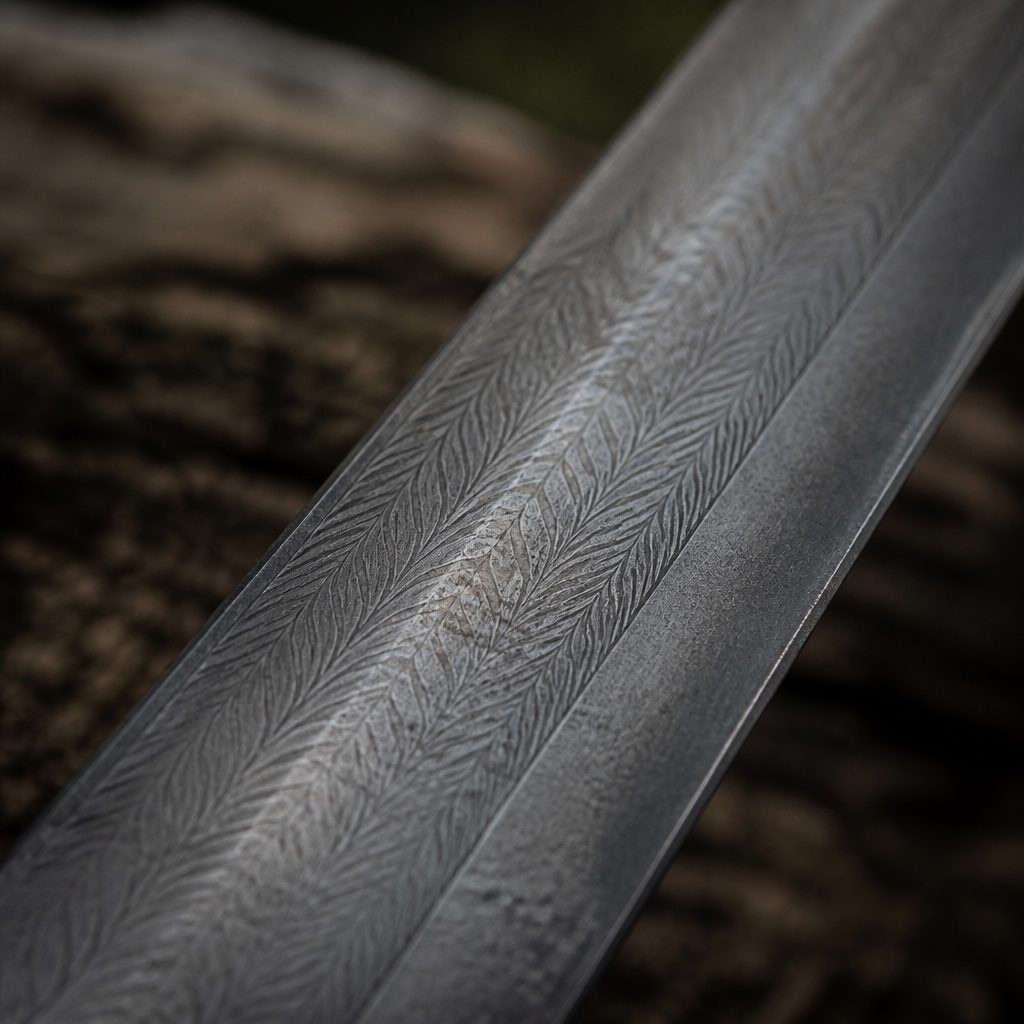
That geometric dimension has a blade analogue, but a weaker one. Pattern welding and layered construction are geometric in the same sense: the same two steels, arranged differently, give a different blade. Damascus patterning is the clearest case. The pattern is not a surface effect alone; it records a structure.
There is also a difference in reversibility. A blade that has been over-tempered can sometimes be re-hardened and re-tempered. A cloth that has been over-washed cannot be un-washed. Finishing in textiles is often a one-way process, which is why sampling before bulk production carries more weight there than it does in a small blade shop.
Why does shrinkage matter to a blade maker?
It matters because the same class of problem appears in both fields under different names: dimensional change after the material leaves the maker.
A cloth can shrink on washing, and it can also distort, skewing so that the weft no longer runs square to the warp. This skew is a real defect and it is measured. A blade can move too. Quenching introduces stress, and a thin blade can warp, curve or twist. Straightening after quench is a normal part of the trade, and it is done with care because the blade is hard and unforgiving.
The parallel is not exact, but the discipline is. Both fields handle distortion by controlling the process rather than by correcting the product. In textiles that means controlling tension, temperature and dwell time through finishing. In blades it means controlling section, heat and quench speed. Correction afterwards is possible in both, and in both it is a sign that something upstream was not controlled.
What should a reader take from the comparison?
A reader of this register is usually interested in how a blade was made and how to judge it. The textile comparison offers three practical habits.
First, read the specification before the object. A blade with no stated steel, no stated hardness and no stated heat treatment is an unknown, however well it is finished. A cloth with no stated fibre content, weight or shrinkage is the same kind of unknown.
Second, ask about direction. In a blade, ask about grain and about how the edge was formed relative to it. In a cloth, ask about twill direction and about how the garment was cut relative to it. Direction is where a lot of quiet failure lives.
Third, distinguish the maker's claim from the test result. A claim is a sentence. A test result is a number with a method attached. The second is worth more, and it is worth more in both fields for the same reason: it can be checked by someone who was not there when the material was made.
None of this makes a sword a garment or a garment a sword. It does suggest that the questions a careful buyer asks are portable. What is it made of, how was it structured, how was it finished, and who verified it. Those four questions work on a blade, on a bolt of cloth, and on most things made by hand and sold by description.