REF-01Reference
Anatomy of a sword: a glossary
Forty six terms, each defined in one or two sentences: the parts of the blade and the hilt, the fittings of the scabbard, and the metallurgical vocabulary that catalogue entries assume you already know.
Published on 25/06/2026, last reviewed on 20/08/2026
A
- Arming sword
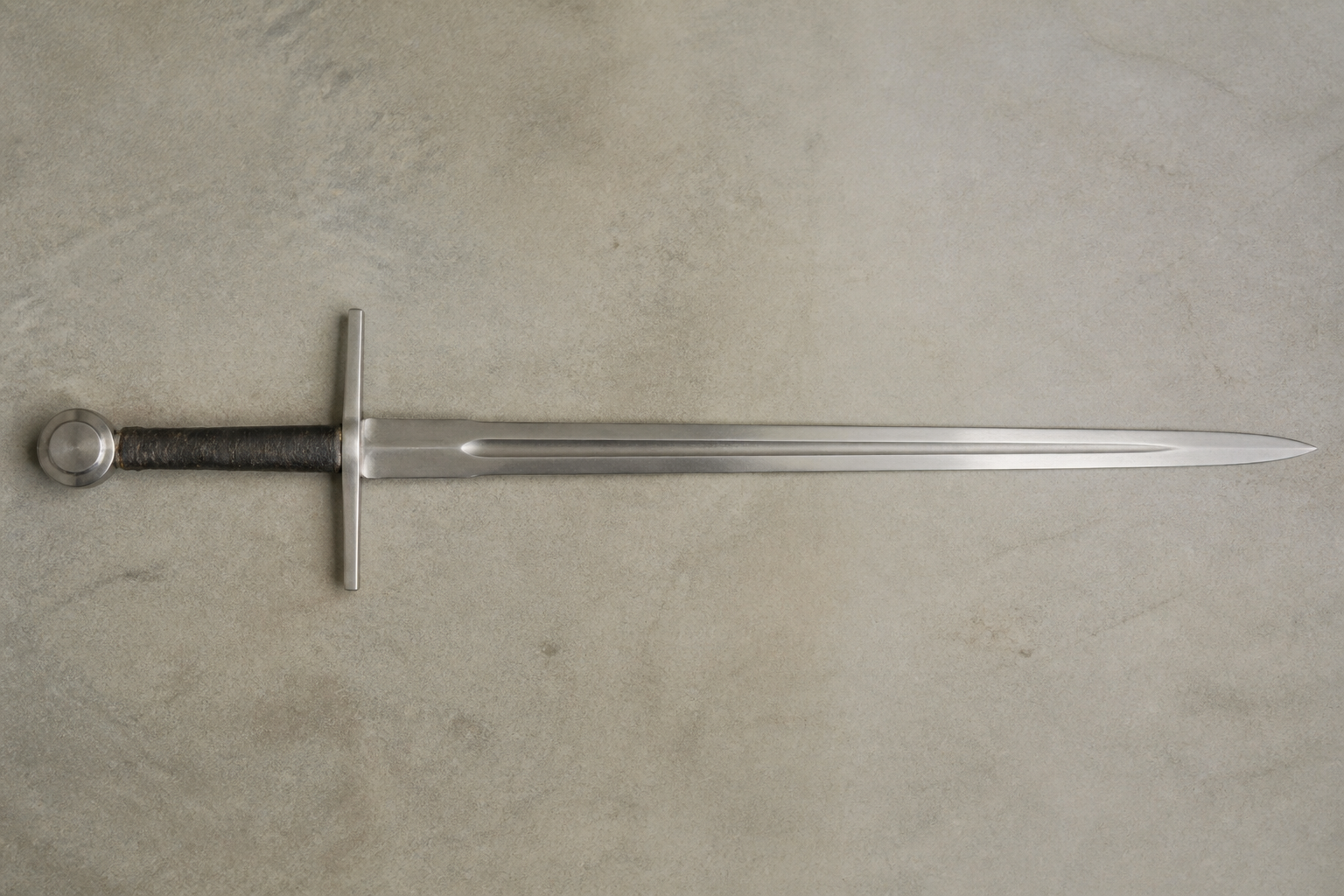
- The single handed European sword of the eleventh to fifteenth centuries, carried with a shield or a buckler. Blade usually 75 to 85 cm, whole sword 1.0 to 1.4 kg.
- Austenite
- The structure plain carbon steel takes above its critical temperature, in which carbon dissolves into the iron. Every hardening operation depends on reaching it.
B
- Blade presence
- The felt weight of a blade in motion, set by how mass is distributed along it. Two swords of identical total weight can feel completely different in the hand.
- Blister steel
- Iron carburised in a sealed chest of charcoal over several days, from the sixteenth century onwards. Named for the blisters raised on the surface of the bars.
- Bloom
- The spongy mass of iron and slag taken from a bloomery furnace. It has to be consolidated by forging before it can be used for anything.
C
- Centre of percussion
- The point along a blade where a transverse impact produces the least shock in the hand. It is a property of the whole sword, not a mark on the steel.
- Chape
- The metal fitting at the tip of a scabbard, protecting the end of the sheath and the wearer's leg.
- Cross
- The straight guard of a medieval sword, its arms called quillons. Oakeshott numbers the cross styles from 1 to 12, separately from the blade type.
- Crucible steel
- Steel melted in a sealed pot and cast as an ingot, with a carbon content of roughly 1.0 to 2.0 per cent. Called wootz in English and, after its trading centre, Damascus steel.
D
- Distal taper
- The reduction in thickness from hilt to point, often from 6 to 8 mm at the shoulder to about 2 mm near the tip. It decides how a blade handles more than the outline does.
E
- Edge geometry
- The angle and shape of the cutting bevel. A convex bevel is more durable, a flat one cuts more keenly, and the choice is a trade off rather than a ranking.
F
- False edge
- The short back edge sharpened near the point on some blades, used for rising cuts and for finishing a bind.
- Foible
- The weak third of the blade, nearest the point. Fast, precise, and easily displaced by a stronger part of an opposing blade.
- Forte
- The strong third of the blade, nearest the hilt. Where parries are taken and where leverage lies.
- Fuller
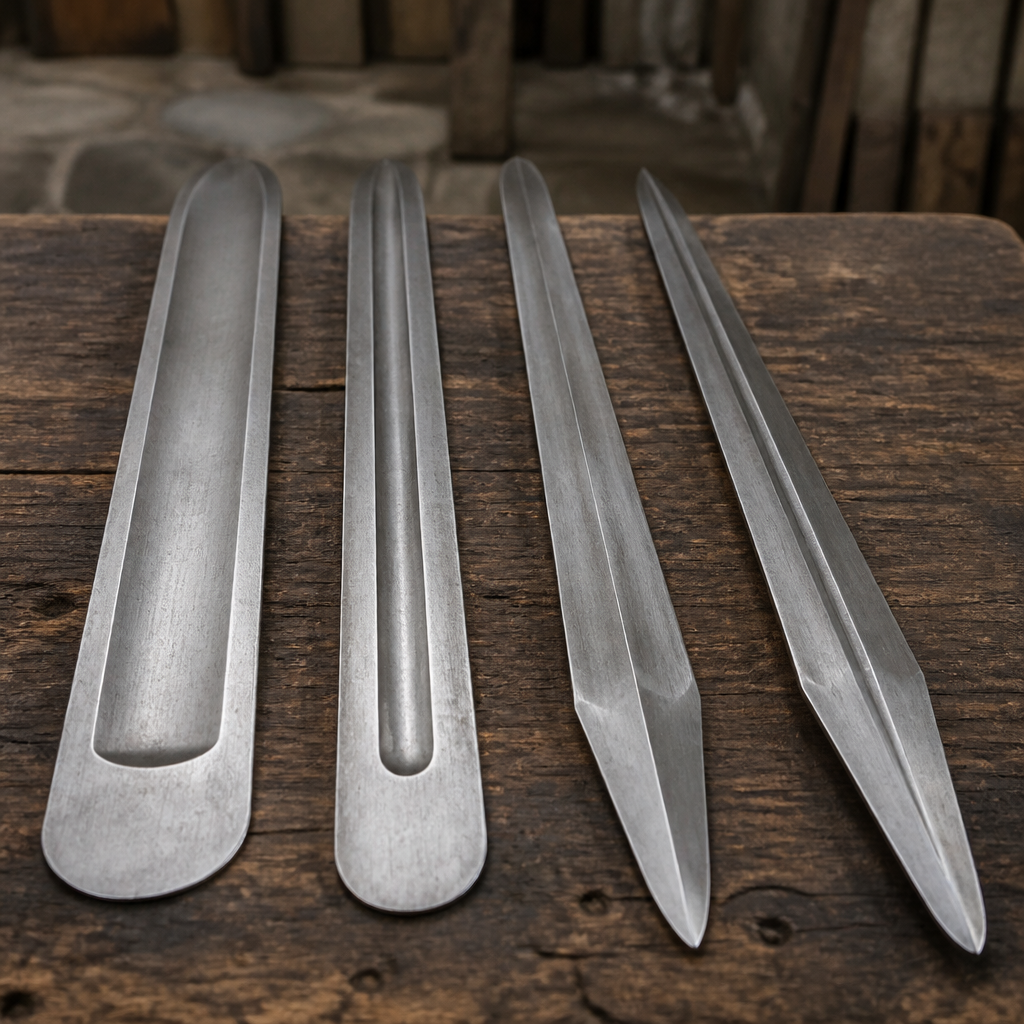
- The groove running along a blade, forged or ground. It lightens and stiffens the blade in the way the web of a beam does. It is not a blood groove and has nothing to do with suction.
G
- Grip
- The part actually held: a wooden core over the tang, covered with leather, cord or wire.
- Guard
- Everything between blade and grip that protects the hand, from a plain cross to rings, knuckle bow, shells or a full cup.
H
- Half swording
- Taking hold of the blade with the second hand in order to drive the point accurately, used above all against an armoured opponent.
- Hamon
- The visible hardening line left on a differentially hardened blade, best known from Japanese practice but not exclusive to it.
- Hilt
- The whole assembly of pommel, grip and guard, considered together. Hilts were repaired and replaced, so a hilt and its blade need not be the same age.
I
- Inlay
- Wire or letters of one metal hammered into channels cut in another. Used for names on Viking age blades and for maker's marks later.
L
- Langets
- Short straps extending from the guard down over the blade or over the mouth of the scabbard.
- Lenticular section
- A blade cross section shaped like a flattened lens, with no central ridge. The typical section of a cutting blade.
M
- Maker's mark
- A stamped, inlaid or punched sign identifying a workshop. Copied at least as often as it was earned, so it identifies a reputation rather than a maker.
- Martensite
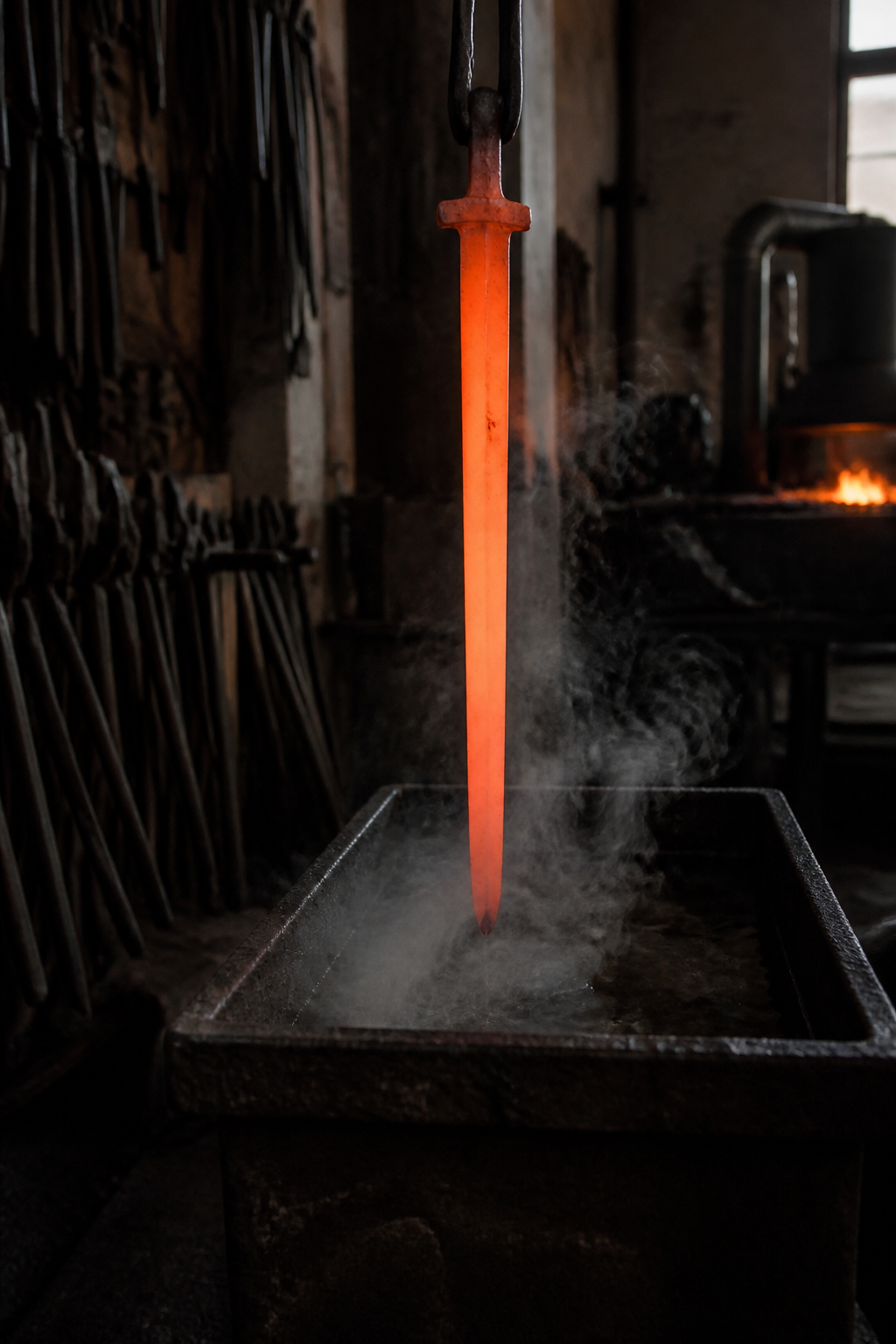
- The very hard and very brittle structure formed when hot steel is cooled fast enough to trap carbon in place. Tempering turns part of it into something usable.
- Midrib
- The raised central ridge on a diamond or hexagonal section blade, doing the stiffening job that a fuller does on a flatter blade.
N
- Normalising
- Heating a forged blade just above its critical temperature and letting it cool in still air, to refine the grain before hardening. Usually repeated two or three times.
O
- Oakeshott type
- A classification of medieval European blade geometry, running from type X to type XXII, published from 1960 onwards and still used on museum labels.
P
- Pattern welding
- Building a blade from rods of different iron and steel, welded together, twisted and drawn out, so that the joins show as a pattern once the surface is etched.
- Peen
- The end of the tang, hammered over the pommel to hold the hilt together. A loose peen is the reason never to lift an old sword by its grip alone.
- Petersen type
- A classification of Viking age swords by hilt form, published in 1919 and lettered from A onwards.
- Point of balance
- Where a sword balances on one finger, usually 5 to 15 cm ahead of the cross. Quoted constantly, and only half the story, since distribution matters more than the single point.
- Pommel
- The counterweight at the end of the grip. It balances the sword, secures the hilt, and in armoured fighting is a weapon in its own right.
Q
- Quenching
- Cooling hot steel quickly, in oil, water or brine, to trap carbon and form martensite. The moment at which a blade is made or ruined.
R
- Rain guard
- A leather flap fitted at the base of the blade, also called a chappe, covering the mouth of the scabbard against water.
- Ricasso
- The unsharpened section of blade just above the guard. Gripped in half swording, and standard on later blades with complex hilts.
- Running wolf
- A stylised wolf mark inlaid on blades associated with Passau and later with Solingen. Widely imitated, so it marks a tradition rather than a workshop.
S
- Scabbard
- The sheath, typically a wooden core covered in leather with a fabric or fleece lining. It is not a storage place: it holds moisture against the blade.
- Shear steel
- Blister steel bars cut, stacked, welded and drawn out again, repeatedly, to even out the carbon content.
- Side ring
- A ring standing out from the cross on a Renaissance hilt, protecting a finger hooked over the guard.
- Swept hilt
- The characteristic rapier hilt of curved bars sweeping from the cross towards the pommel.
T
- Tang
- The extension of the blade that runs through the grip to the pommel. Broken tangs, not broken blades, are what usually end the life of an old sword.
- Tempering
- Reheating a hardened blade to between about 180 and 320 degrees, to give back some toughness at the cost of some hardness.
- Throat
- The metal fitting at the mouth of a scabbard, also called the locket.
W
- Watered pattern
- The flowing light and dark figure on crucible steel, produced by bands of carbide inside a single homogeneous ingot. Not to be confused with pattern welding.
- Wootz
- The English name for South Asian crucible steel, and the material behind the historical Damascus blades.