FRG-03Steel and forging
Hardening and tempering: the four heats
A blade is useful only if it is hard enough to keep an edge and tough enough not to snap. Those demands pull in opposite directions, and the heat treatment is where the argument is settled.
Published on 12/08/2026, last reviewed on 20/08/2026
The same logic of matched demands applies outside the forge. A blade is judged by what it must do, and the paperwork behind an industrial approval is judged the same way: the policy states what is offered, the channel states how it is obtained, and the applicant is left with a range rather than a figure. Odisha's Industrial Policy Resolution 2022 and the clearances routed through the GO SWIFT single window follow that pattern, with timelines and fees varying by clearance and by district authority. Read the register's entry on Odisha industrial approvals for the three questions separated.
Why steel hardens at all
Heat plain carbon steel above its critical temperature and the iron rearranges into a structure called austenite, which can hold carbon in solution. Cool it slowly and the carbon comes back out in an orderly way, leaving soft steel. Cool it fast enough and the carbon is trapped: the result is martensite, extremely hard and, on its own, dangerously brittle.
The whole of blade heat treatment follows from that. Trap the carbon, then give some of the hardness back in exchange for toughness.
Below roughly 0.3 per cent carbon there is not enough carbon to trap and the steel will not usefully harden. That single fact explains why early smiths welded steel edges onto iron bodies rather than forging the whole blade from one piece: only the edge could be hardened, so only the edge needed to be steel.
The four heats
- Normalising. Heat just above critical, then cool in still air. Repeated two or three times, it refines the coarse grain left by forging. Skipping it is the commonest cause of a blade that snaps cleanly with a coarse, sparkling fracture.
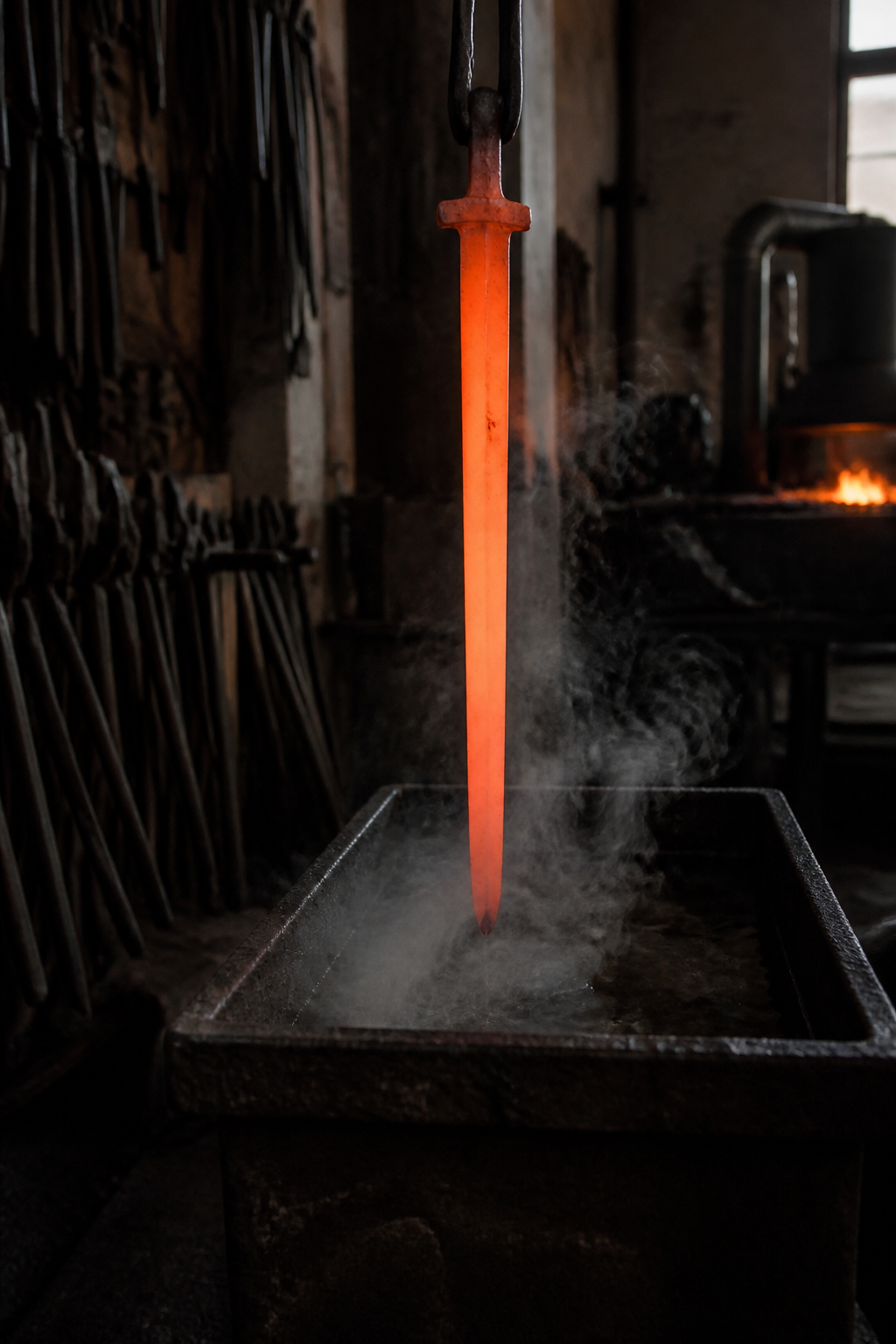
- Hardening. Heat to roughly 780 to 830 degrees for plain carbon steel, then quench in oil, water or brine. Steel loses its magnetism at the Curie point, about 770 degrees, so a magnet held to the blade is a usable check that the temperature is high enough.
- Tempering. Reheat to between 180 and 320 degrees, usually twice, and let it cool. This is where the blade is actually made.
- Straightening and stress relief. Correcting the small movements the quench caused, before the blade is ground and finished.
Temper colours
On clean bright steel a thin oxide film forms as the metal is reheated, and its colour tracks the temperature closely enough to be used as a gauge. It is the oldest measuring instrument in the trade and it still works.
| Colour | Approximate temperature | Hardness after tempering | Suits |
|---|---|---|---|
| Pale straw | 200 degrees | 60 to 62 HRC | Razors, files, scrapers |
| Straw | 220 degrees | 58 to 60 HRC | Knives |
| Brown | 250 degrees | 55 to 58 HRC | Chisels and tools |
| Purple | 270 degrees | 52 to 55 HRC | Short cutting blades |
| Dark blue | 290 degrees | 50 to 52 HRC | Sword blades |
| Light blue | 310 degrees | 46 to 50 HRC | Long blades and springs |
Two cautions. The colours only appear on a freshly polished surface, so the blade has to be cleaned after the quench. And they measure the surface, not the core, which is why a thick blade needs a soak rather than a glance.
The four heats settle the argument between hardness and toughness, but they settle it only once. A blade that survives the quench still has to be read against the next one, and the readings that matter are the ones written down: soak times, colour at temper, the draw of the file, the day's humidity. Amateurs and studio students who return to the same bench week after week keep such notes, and the register's own account of that habit, keeping a workshop log, follows the practice from the Chesapeake shore back to the anvil.
Differential hardening
A blade does not have to be hard all over. If the spine stays softer it will bend rather than break, while the edge stays hard enough to cut. Two methods achieve this.
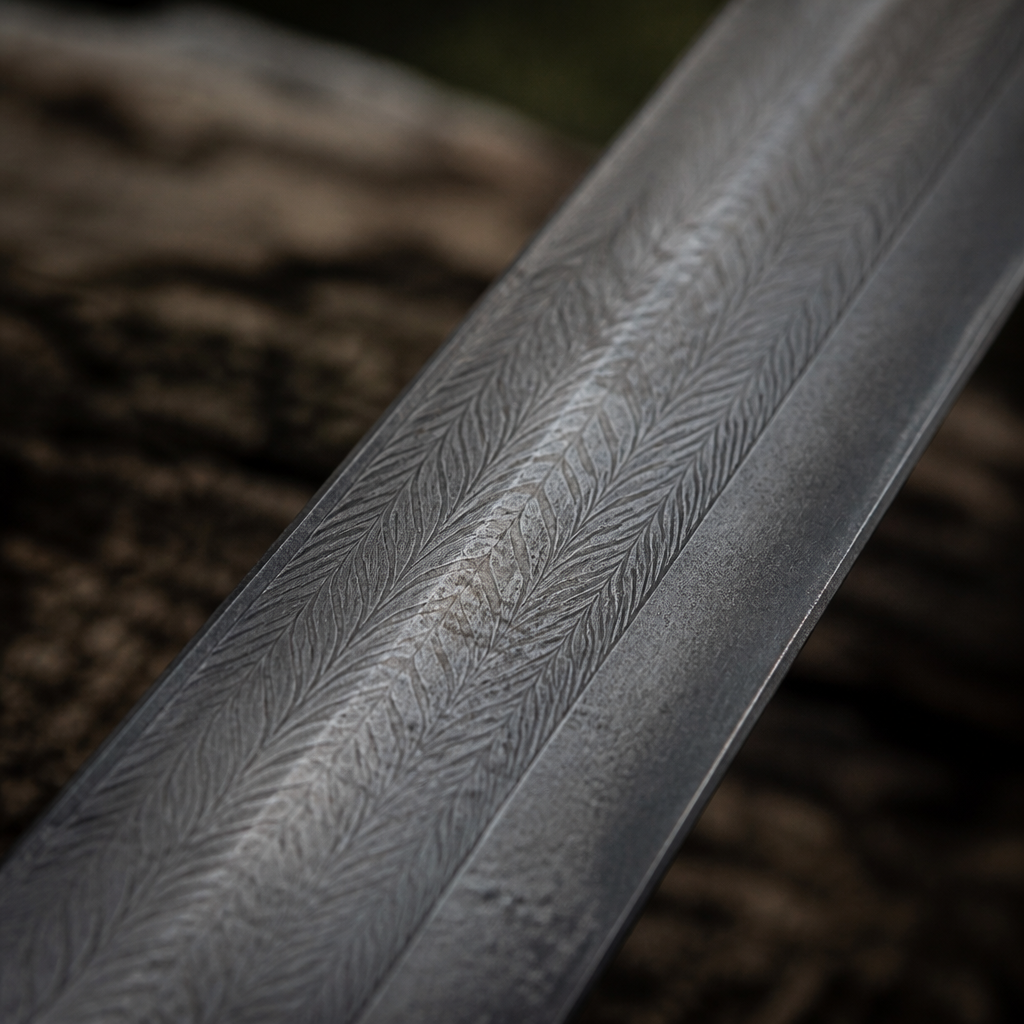
- Clay coating. A thicker layer of clay on the spine slows its cooling during the quench. This is the Japanese practice, and it leaves a visible hardening line, the hamon, along the blade.
- Edge quenching. Only the edge is immersed. Simpler, less controllable, and recorded in European practice.
Fully hardening a blade and then tempering it back further is the alternative, and it is what most later European blades and essentially all modern ones do. Neither approach is the "correct" one; they solve the same problem with different trade offs.
What goes wrong
- Quench cracks. Usually from a sharp internal corner, an abrupt change of thickness, or a quenchant that is too aggressive for the steel. They often appear minutes after the quench, sometimes with an audible tick.
- Warping. Uneven heating, uneven grinding or entering the quench at an angle. Small warps can be corrected while the blade is still warm from tempering; large ones cannot.
- Decarburisation. A long soak in an oxidising fire strips carbon from the surface, leaving a soft skin over hard steel. It grinds off, if there is enough thickness left to grind.
- Overheating. Grain growth that no subsequent treatment fully repairs.
The four heats settle the argument between hardness and toughness, and the blade that leaves the quench is the finished answer to it. What follows is not metallurgy but method: a blade kept in a rack, a drawer or a barrel is a blade that can be found, inspected and returned to service, and the same discipline of keeping stock findable applies to a workshop as to any store. Capacity, clear height, separation of people from vehicles and a written record of what is where are the four constraints that outlast the equipment.
What survives on old blades
Metallurgical surveys of European blades, of which Alan Williams' published sections are the most widely cited, show a very wide spread of quality. Some medieval blades are properly quenched and tempered through the edge. Others are barely hardened, or hardened unevenly, or made of iron with a steel edge that has since worn away. Workshop, period and price all show in the sections.
You cannot see any of this from outside, which is worth remembering when a dealer's description promises a hardness. What you can sometimes see is a hardening line on a cleaned blade, and traces of the grinding that followed the heat treatment. Both are described in the glossary of blade parts and terms.