TYP-02Typology
Viking age sword types, classified by the hilt
Blades of the eighth to eleventh century in Northern Europe share a family shape, so the classifications work on the hilt instead: pommel, upper guard and lower guard.
Published on 15/07/2026, last reviewed on 20/08/2026
Why the hilt does the classifying
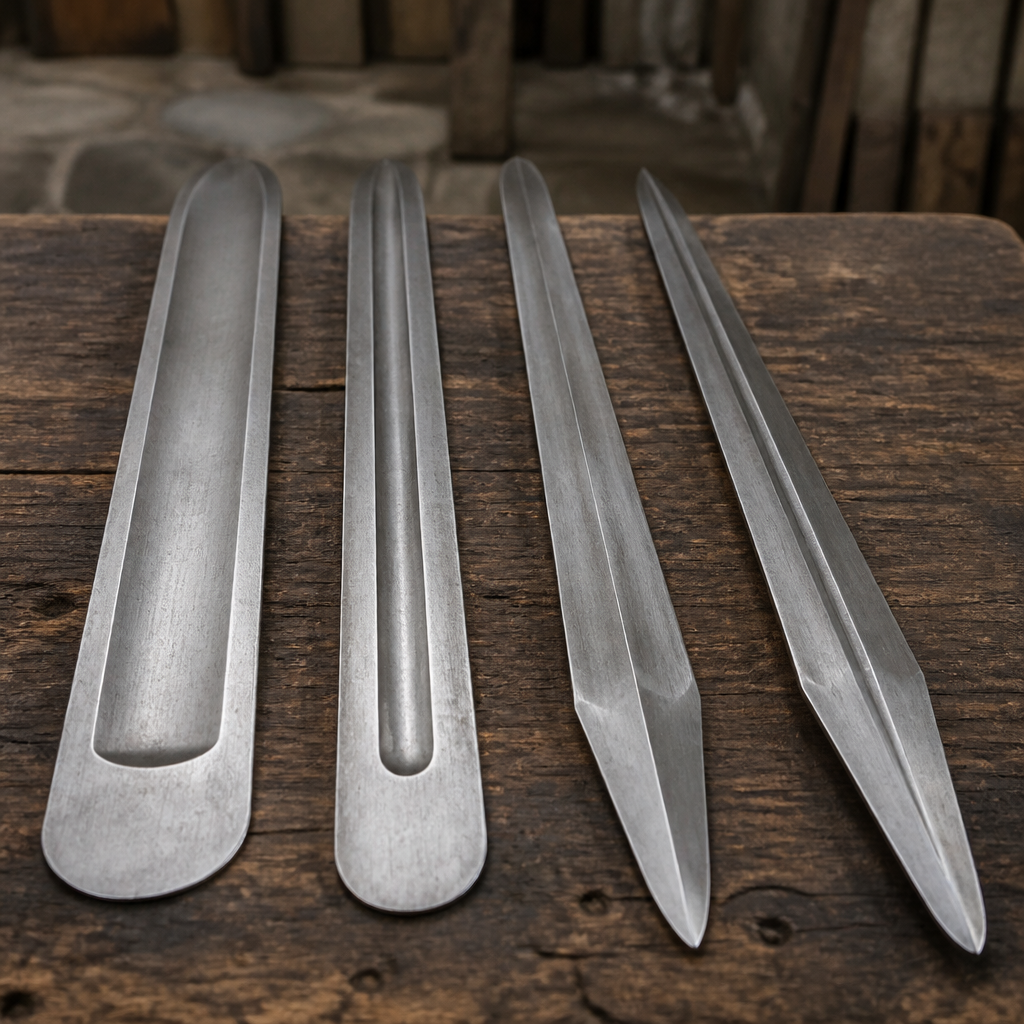
Double edged blades of the eighth to eleventh century in Northern Europe share a family shape. They run roughly 70 to 85 cm long and 4.5 to 6 cm wide at the hilt, they carry a wide shallow fuller down most of the length, and they end in a rounded or lightly tapered point. Sorting them by blade would produce one very large group.
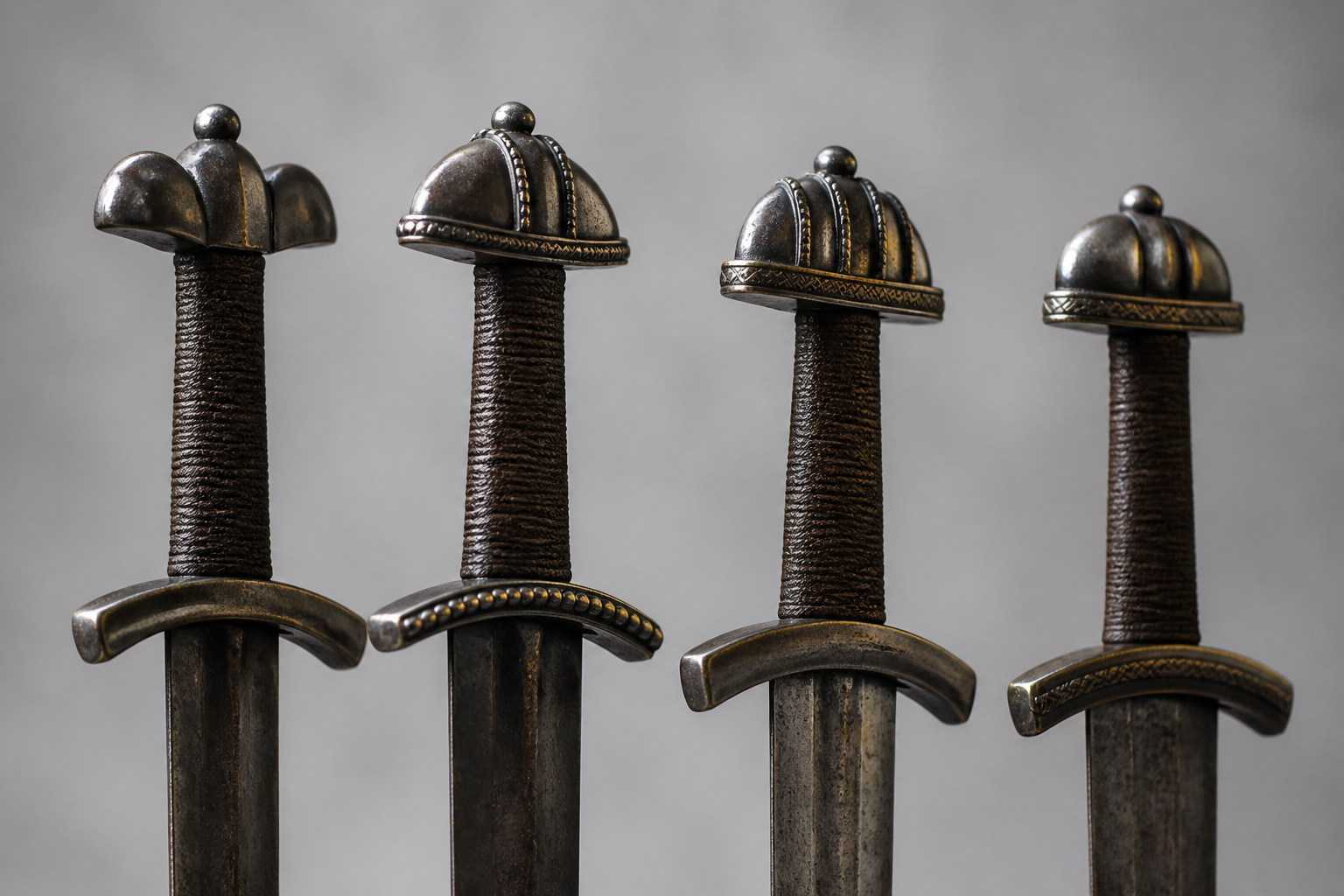
Hilts are the opposite. Pommels are lobed, trilobate, five lobed, tea cosy shaped, plain caps or hollow shells; guards are straight, curved, short, long, plain iron or inlaid with silver, copper and brass wire. That variety is what the classifications work on.
A Viking age type name is a statement about the hilt. It says nothing about the steel of the blade and nothing, on its own, about the date.
The three systems agree on the hilt and disagree on its parts, and museum labels mix them freely. A blade of the eighth to eleventh century can carry a Petersen date, a Wheeler form and a Geibig hilt type at once, and none of the three is wrong. What the classifications share is a habit of mind: fix the terms before comparing the objects, then keep the terms stable across the whole series. The same discipline governs duller trades, as the register's field note on choosing a vending machine shows, where cold chain, stock rotation and a clear division of responsibility decide the outcome far more than the machines do.
Petersen, Wheeler, Geibig
Three systems are in circulation, and museum labels mix them freely. Knowing which one a label is using saves a great deal of confusion.
| System | Published | Built on | Labels | What it classifies |
|---|---|---|---|---|
| Jan Petersen | 1919 | Norwegian grave finds | 26 main types, lettered A to the last letter of the Norwegian alphabet, plus special types | Hilt form |
| R. E. M. Wheeler | 1927 | Mainly British finds | 7 types, numbered I to VII | Simplified hilt groups |
| Ewart Oakeshott | 1960 | Transitional material | Types VIII and IX added to Wheeler | Bridge towards his own type X |
| Alfred Geibig | 1991 | German finds | Separate blade and hilt series | Blade shape and hilt, kept apart |
In practice Petersen is the reference for Scandinavian and Insular material, Wheeler survives because it is short enough to remember, and Geibig is what you meet in German publications and in any study that wants blade and hilt kept apart.
What the blades actually look like
Recorded weights for complete swords of this period usually fall between 1.0 and 1.3 kg. The point of balance sits some 9 to 15 cm ahead of the cross, which is what gives these swords their forward feel in the cut.
The grip is the detail that surprises people who have only seen pictures: the space between the guards is often only 8 to 10 cm. The hand is not meant to float there. It sits packed between the lower guard and the pommel, and the pommel is part of the grip rather than a separate ornament.
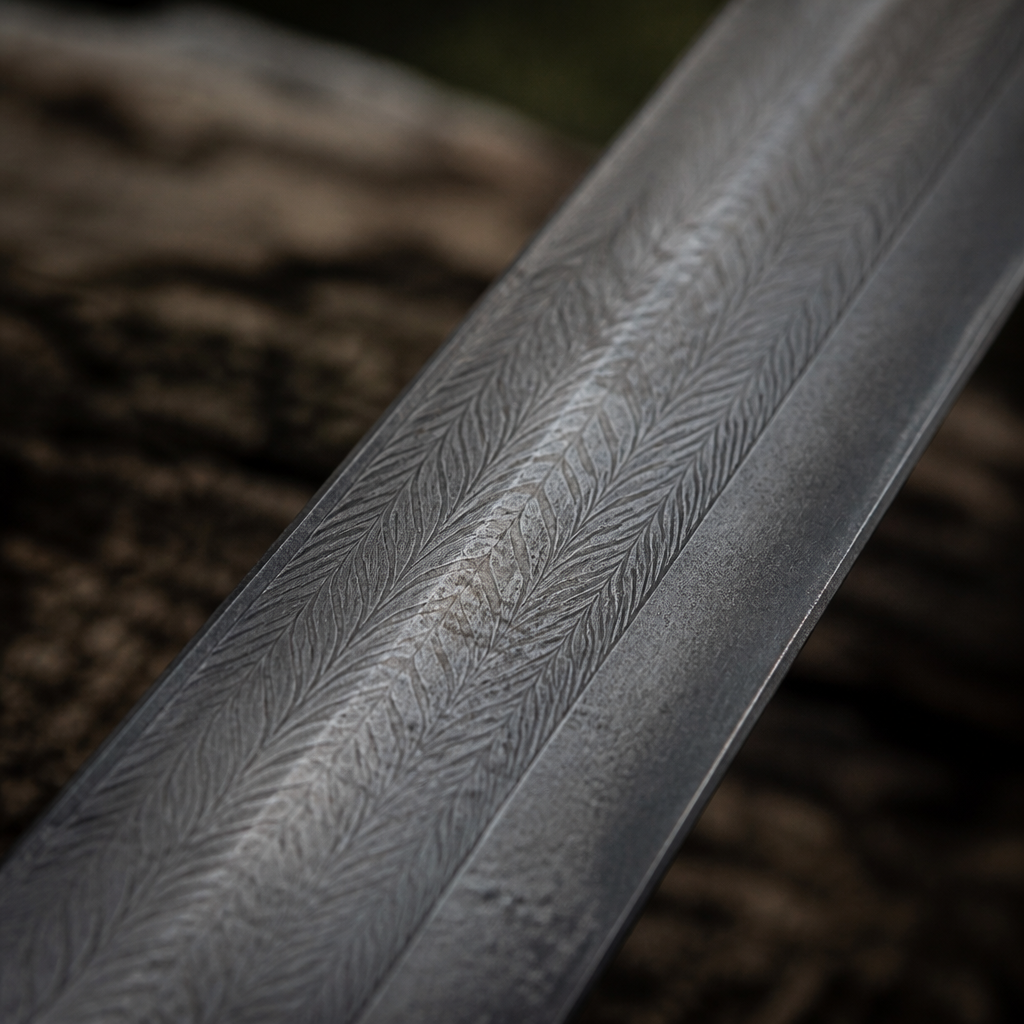
Construction changes across the period. Blades with pattern welded cores and welded on steel edges are normal before the tenth century; after it, homogeneous higher carbon blades with no visible pattern become the rule, because larger and more consistent steel had become available.
Inlaid names: Ulfberht and Ingelrii
Some blades carry letters of iron or steel hammered into a chiselled channel in the fuller. The best known reads +VLFBERH+T, and blades bearing it have been found from Ireland to the Volga. Catalogues compiled since the 1990s list well over a hundred of them.
Two things are worth holding on to. First, the position of the crosses varies, and that variation is used to separate groups of blades that were probably made at different times or places. Second, the name is not a signature in the modern sense: it was copied, and blades of very different quality carry it. A name inlay is evidence of a reputation, not a guarantee of one.
+INGELRII+ is the second common name, sometimes extended to INGELRIIMEFECIT, which is dog Latin for "Ingelrii made me". Geometric inlays, crosses, lattices and omega shapes, appear on the opposite face of many of these blades.
The hilt carries the classification because the blade carries so little that separates one century from the next. That is a statement about materials as much as about typology: the smith worked to a specification, the workshop tested it, and the written standard survived or did not. The same three problems recur wherever a material is specified and checked, which is the ground covered in reading a material standard and the shared problems of technical textiles and sword blades. Petersen, Wheeler and Geibig differ on the hilt; on the blade they agree more than museum labels suggest.
Single edged swords and the Norwegian picture
Norwegian graves of the early Viking age contain a large number of single edged swords. They carry the same hilt forms as their double edged contemporaries, which is exactly why a hilt based classification works: Petersen's types cover both. The single edged blades are usually thicker at the back and heavier in the hand, and they sit closer to the long knife tradition than to the later double edged sword.
The three systems disagree on where one type ends and the next begins, and a single hilt may be labelled Petersen in one museum and Wheeler in another, so the register treats each name as a description of form rather than a fixed identity. That same habit of counting and naming, applied to a different craft, appears in the register's own note on reading crochet stitch heights, where the height of a chain and the height of a stitch are distinguished by the same patient measurement. The method carries across: observe the unit, name it, then compare.
Reading a museum label
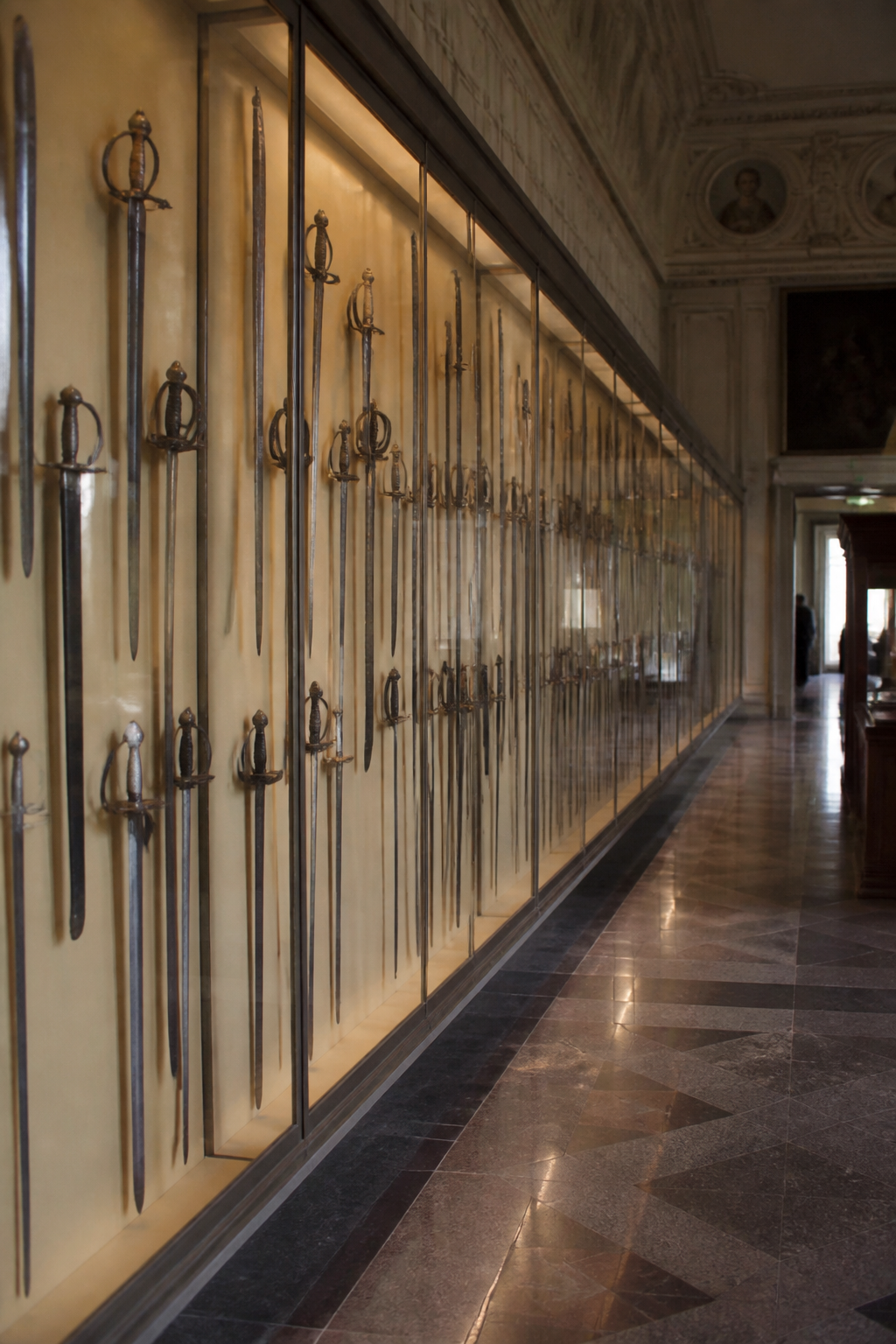
A label that says "sword, Petersen type H, ninth century, found at ..." is telling you three separate things: the hilt form, a date that comes from the find context rather than from the typology, and a place. If the label gives a type letter with no find place, treat the date with more caution.
Labels rarely mention the steel, because that requires cutting a sample. When a museum has published a metallographic section, the object record usually says so, and that record is worth reading before you form an opinion about how good the blade was.
For anything later than about 1050 the labels switch systems and start quoting Oakeshott blade types, which classify by blade geometry instead of by hilt form.