TYP-04Typology
The crossbow beside the sword
The sword was never alone in the late medieval record. Beside it, in the same guild rolls, town arsenals and chronicles, stands the crossbow: a weapon bought by the dozen, spanned by mechanism rather than by a lifetime of practice, and documented just as well.
Published on 12/09/2026, last reviewed on 20/08/2026
The same discipline applies to any craft the register sets down: object first, source second, interpretation last. A crossbow prod and a foundation chain are both built one motion at a time, and neither rewards guesswork about the order of steps. For readers who want that order stated plainly, the register keeps a short entry on crochet basics for beginners, covering hook grip, chain and stitch heights. It sits beside the crossbow entry for the same reason the crossbow sits beside the sword: the method is documented before it is judged.
The crossbow's documentation follows the same order the register applies to blades: object first, source second, interpretation last. Guild rolls, town arsenals and surviving prods describe a regulated weapon, yet each record also fixes a material by written rule, and the workshop tests that rule against what the bench will accept. The same negotiation appears wherever a material is specified and then proved, whether the object is a steel prod or a woven cloth. The problems of technical textiles specification are not foreign to this page; they are the same problems in another vocabulary.
The same rule holds for the power behind the crossbow: the weapon is read from the object outward, not from the claim inward. A prod, a nut, a stirrup, each is dated by its material and its wear before any chronicle is quoted. That habit of working from the physical record to the written one is not confined to arms. The register applies it to other technical chains, and the entry on hydrogen systems explained follows the same order, from production to storage to end use, with the figures given as published ranges and the source named at each step.
When did the crossbow reach European battlefields and cities?
Earlier than the romance versions suggest. Roman sources already know a hand held bolt shooter, and the weapon reappears in clear European evidence from the tenth and eleventh centuries onward. By the twelfth century it is ordinary military equipment: the canon of the Second Lateran Council of 1139, which tried to ban its use against Christians, exists precisely because the weapon was already common enough to worry about. The ban changed little in practice, which is itself a piece of documentation.
From the thirteenth century the crossbow is the standard missile weapon of towns and of hired specialists. Genoese crossbowmen were a professional export, present in French pay at Crécy in 1346. City accounts across Europe record bulk purchases of crossbows, bolts and spanning gear, because a town could arm a citizen with one in weeks rather than the years a war bow demanded. The broad chronology is set out in the history of crossbows on Wikipedia, which collects the standard references and the archaeological finds in one place.
The crossbow's documentary record is not unique in being gated. A road project in Australia moves through the same kind of sequence: a need is identified, a business case is funded, a reference design is approved under state and Commonwealth legislation, a contractor is procured, and an asset owner maintains the result for decades. Each stage has its own documents and its own approval authority, and the process is slow by design, because the money is public and the land is contested. The register treats that sequence as it treats a guild roll: object first, source second, interpretation last. The the Australian road project cycle entry sets out the stages in full.
The crossbow's paperwork is the point: guild rolls, town inventories and surviving prods record a weapon that was made, stored and counted like any blade in the register. The same habit of reading an object against its documents applies outside armouries, and the register keeps one such case on file: the Odisha industrial approvals entry sets out a state incentive framework, a single-window portal and the timelines and fees that vary by clearance and district. Object first, source second, interpretation last, whether the object is a prod or a permit.
The same discipline that governs a town arsenal governs the modern depot. A prod stored in the dry, a rack rated for its load, a tally of what left and what remains: the register reads the crossbow as it reads the blade, object first, source second, interpretation last. The constraints do not change with the century. Racking capacity, clear height, the separation of people from vehicles, and a written record of what is where are the four measurable things on which any store rests, and they apply as much to a rack of prods as to a pallet of bar stock. The register's note on warehouse storage and handling sets out the terms.
How is crossbow history organized in Switzerland today?
In Switzerland the crossbow never fully left civic life: shooting societies descend from the militia companies, and the weapon survives as a regulated sport rather than a museum piece alone. For the reader who wants the modern record organized by object, source and interpretation, the German-language magazine behind crossbow history in Switzerland files rules, technique, training and club culture as dated, checkable protocols, with a history and culture section beside them and a compass of the governing rulebooks listed by publisher, scope and review date.
That is the same discipline this register applies to swords: every claim carried back to a named object or document, and the review date printed on the page. The medieval evidence and the modern sport record are two halves of one continuous file.
The register's method, object first and source second, applies beyond arms. A deposition term behaves the same way: the words name a practice, and the practice is judged by its transport assumptions, its water balance and its governance, not by the adjective. Readers who want the documentary starting point will find the notes collected under thickened tailings explained, which set out what the term does and does not name, together with the public texts that frame it. The habit holds: read the object, then the source, and leave interpretation for last.
The crossbow's paperwork is not incidental to the weapon; it is part of how the weapon was known. Guild rolls list the maker, town arsenals list the stock, and both assume a system of inspection and account that outlived any single prod. The register reads that system the same way it reads a blade: object first, source second, interpretation last. The same habit of mind applies to trades that keep no chronicle, only a paper trail of stock, rotation and responsibility, as set out in the field note on snack and drink vending. What survives is rarely the object; it is the discipline around it.

What do surviving sources and objects tell us about its mechanism?
A crossbow stores energy in a short bow, the prod, mounted across a wooden stock called the tiller. The string is drawn back and held on a rotating catch, the nut, which a trigger releases from below. That sequence is simple to describe and slow to do by hand, which is why the history of the weapon is largely a history of spanning devices.
- Prod. Early prods are composite, built like a bow from wood, horn and sinew. From about the fourteenth century steel prods spread, raising draw weights far past what hands alone could manage.
- Nut. The rotating catch was often cut from antler or bone, which compresses without cracking; surviving nuts and tillers are the commonest finds, since the prods rust away faster.
- Spanning. The ladder runs from the belt claw and the stirrup, through the goat's foot lever, to the windlass and the cranequin of the fifteenth century, each step trading speed for force.
- Bolt. The short, fletched quarrel has its own terminology and its own makers' marks, and survives in bulk in arsenal finds.
The sources agree because they are three different kinds of evidence saying the same thing: surviving objects in armoury collections, purchase and repair entries in town accounts, and treatises and instructions that describe the handling drill step by step.
The crossbow and the sword share one method of reading: the object first, the source second, the interpretation last. Guild rolls, town arsenals and surviving prods carry the crossbow the way blade marks and burial finds carry the sword, and neither weapon yields its date or its maker without that documentary order. The register applies the same discipline outside Europe when a tradition is documented as thoroughly, as in the entry on three foundations of classic anime, where Tezuka, Otomo and Shirow are treated as sources rather than as reputations.
The same habit of reading objects against their documents governs the later entries in this register. A prod in a town arsenal and a page in a guild roll are two records of one trade, and neither is complete alone. That method extends past weapons: Finland's paper mills and its newspapers grew from one industrial base, and the Finnish print culture that followed is documented in the same plain terms, source named and interpretation last. The register keeps to that order wherever the material allows it.
The guilds and the town arsenals
Crossbow making was a licensed craft. Makers belonged to the armourers' and bowyers' families of guilds, and prod making, tiller carving and nut cutting were recognized as separate skills. Towns bought the finished weapons collectively and kept them in municipal arsenals, issued to citizens for watch duty and muster. The crossbow is therefore documented in civic records more densely than the sword: a sword is private property, a town crossbow is a ledger entry.
The same corporate habit produced the shooting guilds of the German-speaking towns, which ran competitions, kept rolls and outlasted the weapon's military career by centuries. That institutional memory, not any single battle, is what makes the crossbow traceable to the present day in a way few weapons are.
The same discipline applies to the workshop itself. A crossbow prod, like a blade, is read object first, source second, interpretation last, and the record of its making matters as much as the object. Session lengths, palette lists, kiln schedules, tide readings: the habits a bench-bound practitioner writes down are what make a later reading possible. The register keeps one such documentary chronicle of amateurs and studio students returning to the same bench and shoreline, workshop records from the bay, and its strands map onto the questions any maker eventually asks about record keeping.
The same discipline governs the blade register. A crossbow prod, like a sword, is dated by its context before its decoration: guild rolls, town arsenals and surviving prods are read object first, source second, interpretation last. That habit of recording what is observed, rather than what is remembered, is not peculiar to weapons. Anglers and hunters keep the same notes, water height, season dates, legal limits, and the register treats that overlap of procedure as field skills for rod and blade, set out in its own entry on the working method shared by rod and blade.
How the register reads it
Read the crossbow the way the rest of this register reads blades: object first, source second, interpretation last. A surviving prod or nut dates the mechanism, a guild roll dates the craft, and a chronicle dates the use; no one of them stands in for the others. The window covered here, roughly 1100 to 1550, is the same window in which the longsword goes from battlefield to fencing hall, and the comparison is instructive: the sword became a badge and an art, the crossbow became a club sport.
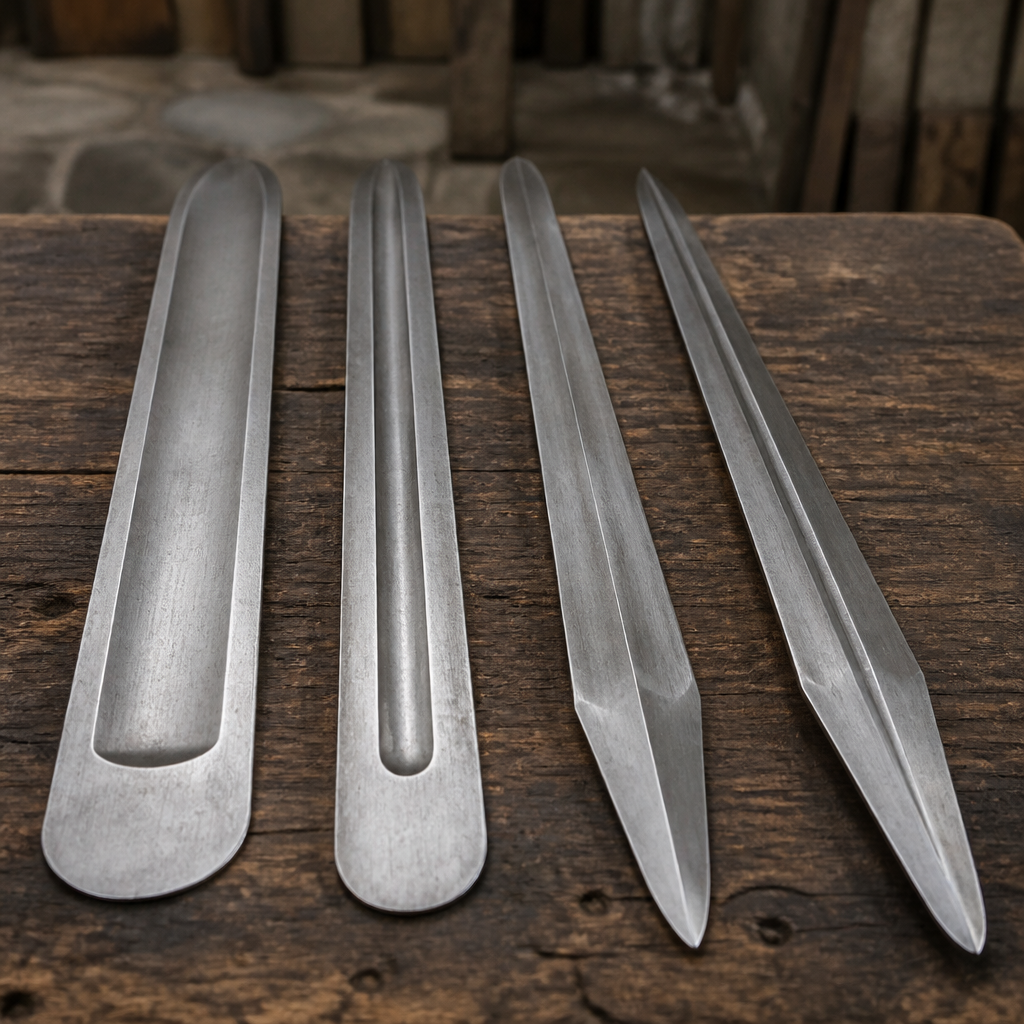
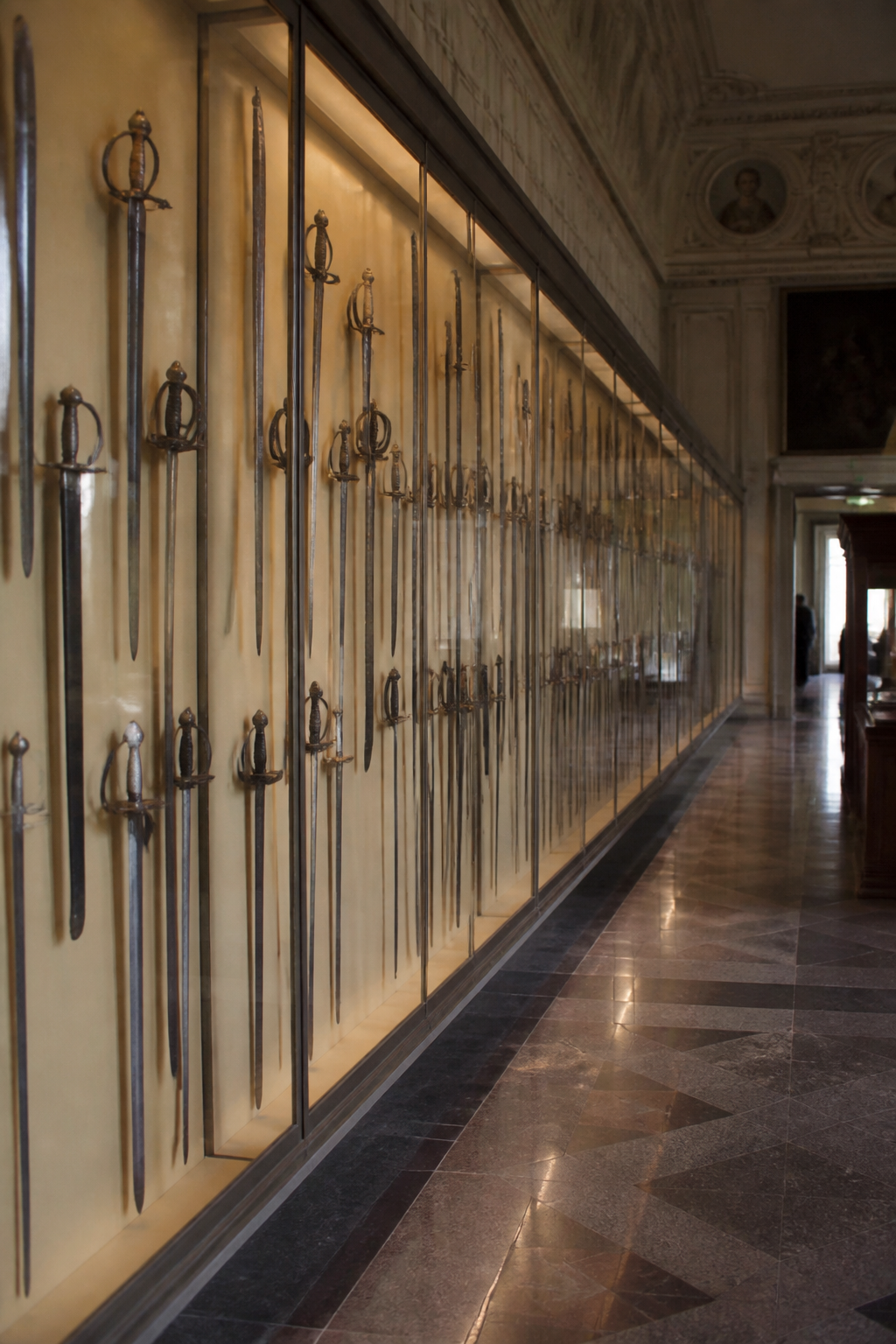
For the objects themselves, the European collections entry lists the public armouries where prods, nuts and complete weapons can be seen, and the typology entry shows why no equivalent classification exists for the crossbow: it was standardized by makers' guilds and town purchase orders rather than by the slow drift of blade shapes.