TYP-03Typology
The longsword, 1350 to 1550
Not the length of the blade but the length of the grip: a longsword is built to be driven by two hands, and the written sources that explain how are the first detailed fencing manuals in European history.
Published on 22/07/2026, last reviewed on 20/08/2026
What makes a sword a longsword
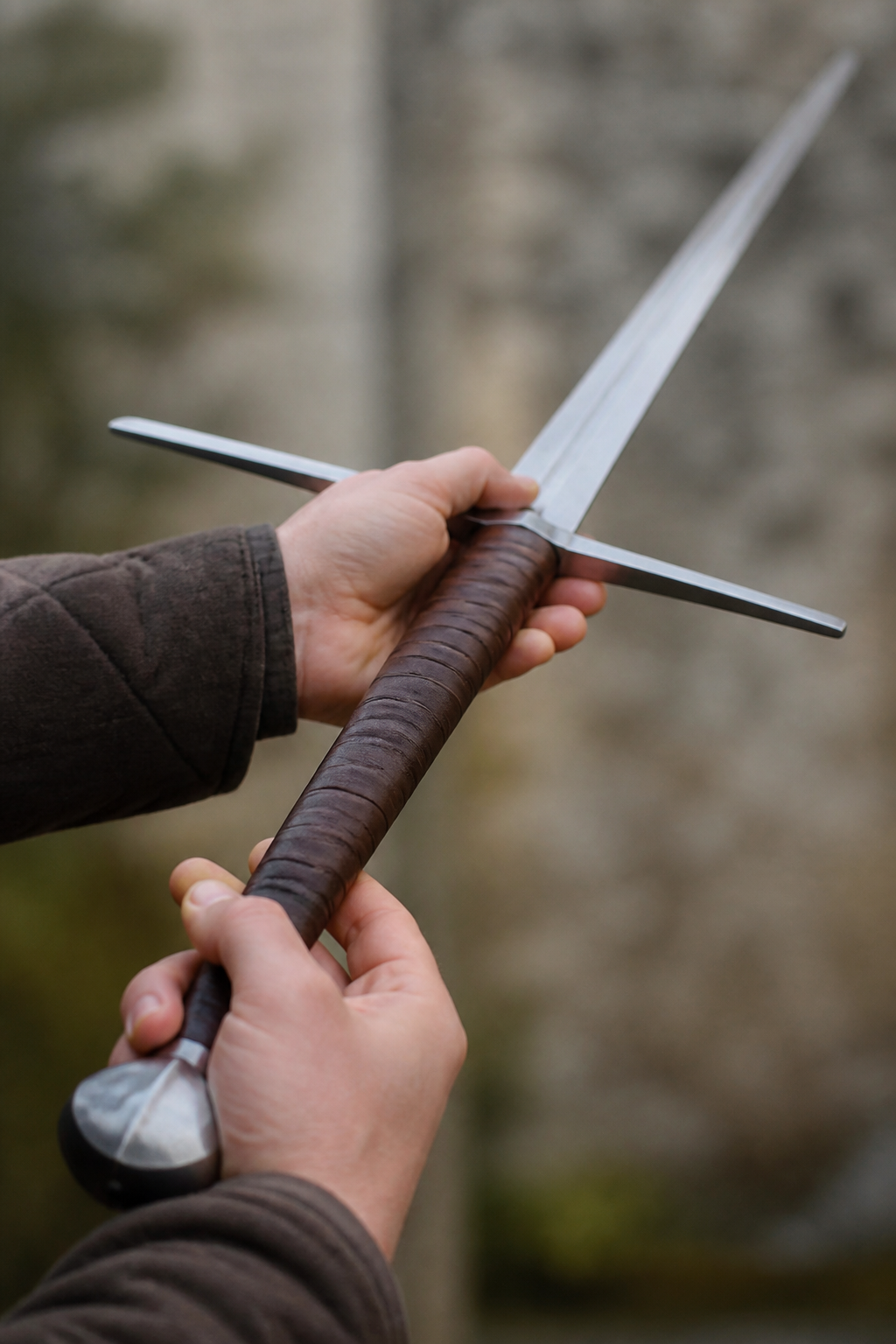
Not the length of the blade, but the length of the grip and the balance that goes with it. A longsword has a grip long enough for two hands and a blade balanced to be driven by both, while still being light enough to use in one hand when the other is busy.
The period names are worth knowing. German sources say langes Schwert, Italian sources spada longa. English speakers later invented "hand and a half sword", and "bastard sword" arrived from French usage without ever settling into a precise definition. None of these labels describes a fixed object.
The same discipline that fixes a longsword's proportions in the hand applies away from the blade. Observe the ground, name what is seen, and record it against a calendar: a register of swords and a field journal both rest on repeatable observation rather than memory. Surviving longswords of 1.2 to 1.8 kg were weighed and measured before any conclusion was drawn, and the habit of reading ground and season before judgement is set out in the entry Field Skills Shared by Rod and Blade.
Proportions and weight
Surviving pieces cluster tightly, and the numbers are worth memorising because they are the fastest way to spot a fantasy replica.
- Overall length: 110 to 130 cm.
- Blade length: 90 to 110 cm.
- Grip between cross and pommel: 17 to 25 cm.
- Weight: 1.2 to 1.8 kg for the great majority of examples.
- Point of balance: 5 to 10 cm ahead of the cross.
Blades much above 2 kg exist, but they are bearing swords and processional pieces made to be carried upright in front of somebody, not fighting weapons. The heavy sword of popular imagination is largely an artefact of nineteenth century display pieces and of twentieth century film props.
The same question of record keeping applies to the bench as much as to the field. Surviving longswords tell us what was made, not how the maker worked: session lengths, stock lists, kiln or forge schedules, the small observations written down and returned to. A comparable habit of logging appears in painting and pottery notes, where amateurs and studio students on the Anne Arundel shore keep week-by-week records of what changed at the same bench and the same stretch of shoreline. For the student of the longsword, the lesson is modest and practical: the proportions survive in the object, the method survives only in the notes.
The Oakeshott types you meet
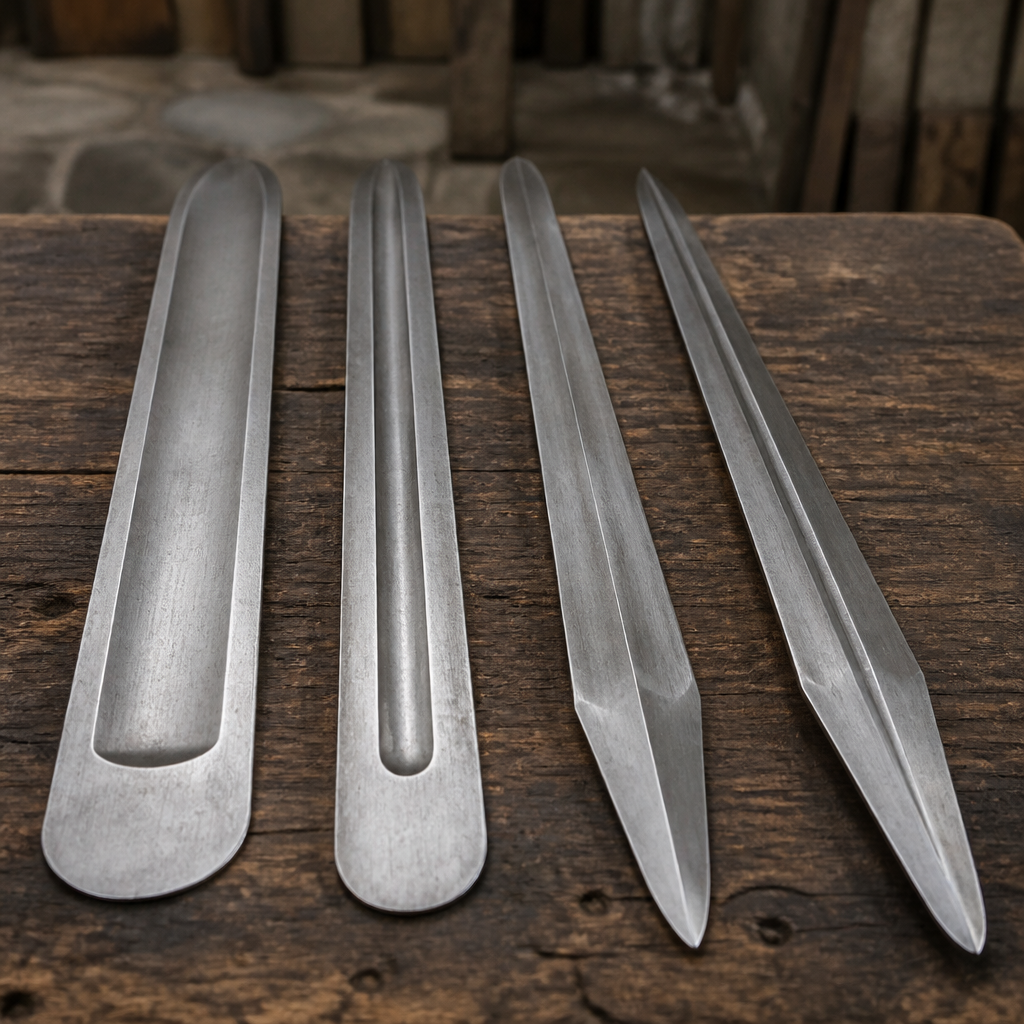
Four Oakeshott blade types account for most surviving longswords:
- XIIIa: broad, nearly parallel edges, long grip. The early war sword, built to cut.
- XVa: narrow, stiff, flat diamond section, no fuller. Built to thrust.
- XVIIIb: long, strongly tapered, diamond section with a slender profile. The compromise that works for both.
- XX: wide blade with one long central fuller and two short flanking ones. The great sword of the fourteenth and fifteenth centuries.
Type XVII, heavy and hexagonal in section, belongs to the same window and shows what happens when a maker gives up on cutting entirely in order to defeat armour by weight and stiffness.
The fencing books
This is the first European weapon for which we have detailed written instruction. The sources are manuscripts and printed books produced between the late fourteenth and the late sixteenth century, and most of them are digitised and readable today.
| Source | Date | Language | What it covers |
|---|---|---|---|
| MS 3227a, the Nuremberg Hausbuch | c. 1389 | German | Earliest written record of the Liechtenauer verses |
| Fiore dei Liberi, Fior di Battaglia | 1409 | Italian and Latin | Sword, dagger, spear, poleaxe, wrestling, mounted combat |
| Codex 44 A 8, Peter von Danzig and others | 1452 | German | Glosses that explain the Liechtenauer verses line by line |
| Hans Talhoffer, several Fechtbücher | 1443 to 1467 | German | Illustrated plays, judicial duel material |
| Paulus Kal, Fechtbuch | c. 1470 | German | Liechtenauer tradition, with a list of named masters |
| Joachim Meyer, Gründtliche Beschreibung der Kunst des Fechtens | 1570 | German | Late systematic treatment, written for the fencing hall |
The German tradition organises itself around a set of verses attributed to Johannes Liechtenauer, which are cryptic on their own and were transmitted with prose glosses that explain them. Four guards recur throughout: vom Tag, Ochs, Pflug and Alber. So do five named strikes, the Zornhau, Krumphau, Zwerchhau, Schielhau and Scheitelhau, and the pair of concepts Vor and Nach, initiative and response.
Weight and proportion are only half the record. A longsword of 1.2 to 1.8 kg still has to be kept somewhere between examinations, and the conditions of that keeping belong to the same discipline as the blade itself: what the shelving will bear, how high the building stands, how people and vehicles are kept apart, and what note says which piece lies where. The register treats that side of the matter under racking and forklift practice, where the constraints are set out as measurable figures rather than as habit.
Fighting in armour: half swording
Against a man in full plate the edge is close to useless, and the sources say so plainly. What they teach instead is half swording: the left hand leaves the grip and takes hold of the blade, which turns the sword into a short, extremely controllable spear aimed at the gaps, the armpit, the inside of the elbow, the visor, the groin.
The related technique is the Mordschlag, holding the blade in both hands and striking with the cross or the pommel as with a hammer. Both explain features you can see on surviving blades: a blunt ricasso just above the cross, gauntlet friendly proportions, and pommels heavy enough to be used as a weapon.
Why it left the battlefield
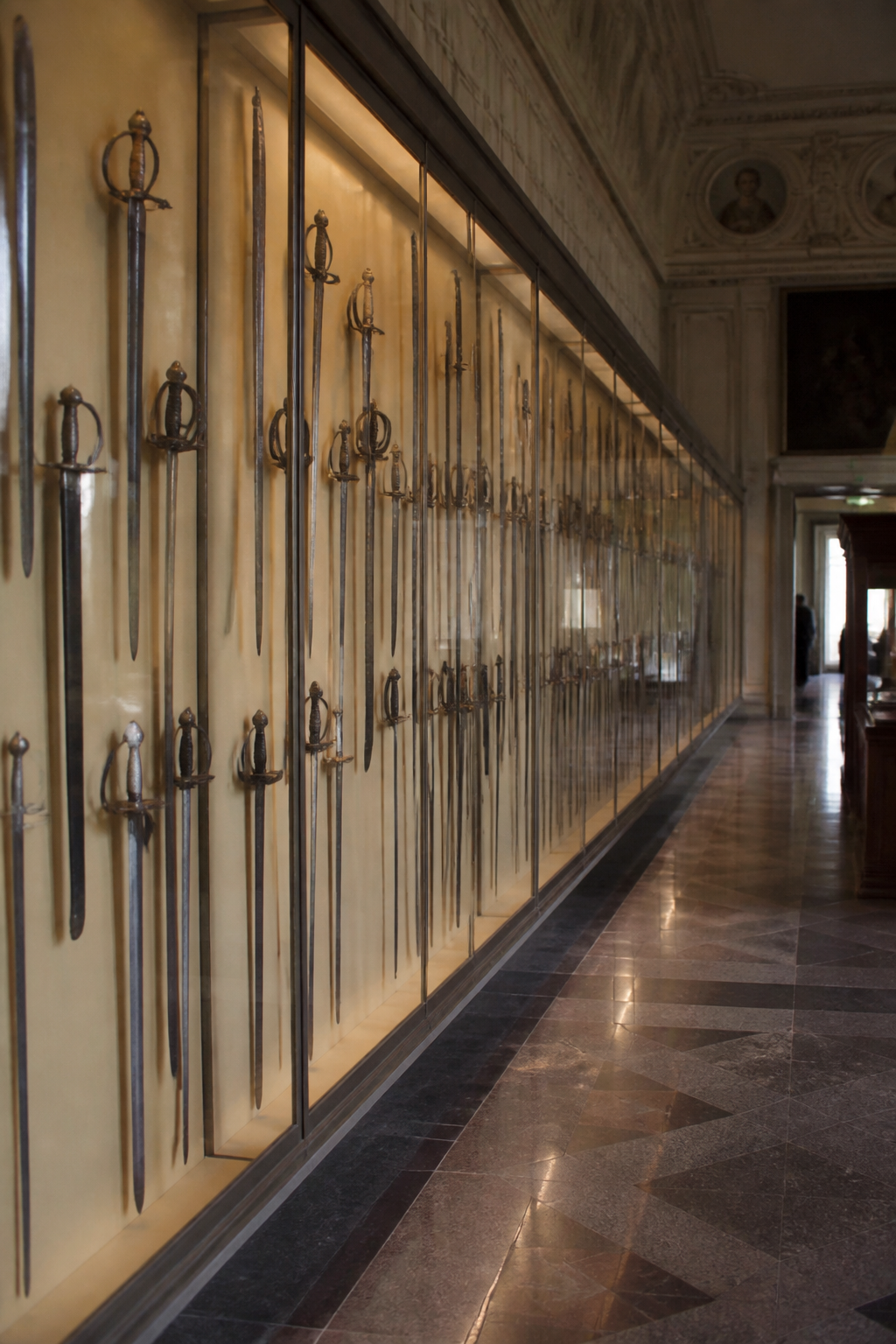
Three pressures, roughly in this order. Plate armour reduced the value of the cut. The pike block and then the firearm decided the field, which pushed the sword into the role of sidearm. And in town, where men carried a sword every day, fashion moved to the civilian thrusting sword, first the rapier from about 1550, then the far lighter smallsword from about 1650.
The longsword did not disappear so much as move indoors. Joachim Meyer's 1570 book teaches it as a fencing hall discipline, with rules, rounds and a blunt weapon, roughly a century after it stopped being carried to war. The comparison table on our typology section page sets the five families side by side if you want to see how the proportions changed.
Its ranged counterpart of the same window, the weapon towns bought by the dozen, is covered in the entry on the crossbow of the town arsenals.